
"At long last, the battle has ended! And thus, Ghana, your beloved country is free forever!"
These were the words of Dr. Kwame Nkrumah as he addressed an excited nation on March 6, 1957. Standing before thousands of Ghanaians at the old Polo Grounds in Accra, he announced what generations before him had fought, suffered and hoped for: freedom from colonial rule.
But there was something else in that speech that deserves just as much attention.
Nkrumah said, "We must realise that from now on we are no longer a colonial but a free and independent people." He also reminded Ghanaians that independence came with hard work and the responsibility of reshaping the country's destiny.
It was a declaration of freedom, but it was also a declaration of responsibility.
Almost seven decades later, Ghana has grown, changed and experienced its fair share of triumphs and disappointments. We have built institutions, educated generations, expanded our cities and made progress in areas that were once beyond the imagination of many.
Yet, when we look around us today, it is difficult not to wonder whether we have become the country our forefathers imagined.
Before independence: The Ghana we inherited
Before Ghana became Ghana, it was known as the Gold Coast, a territory under British colonial administration.
And while colonial rule brought its own structures, opportunities and developments, life was not the same for everyone.
For an ordinary person, access to some of the things we consider basic today was limited.
Education, for instance, was not something every child could easily access. Schools were concentrated in certain areas, particularly along the coast, and the cost of education discouraged many families from sending their children to school. For some households, investing in a child's education was a difficult financial decision, especially when that child could be contributing to the family's livelihood.
In fact, research into colonial education in the Gold Coast shows that many parents were reluctant to enrol their children because the costs were high and the employment opportunities available to school leavers were limited.
Healthcare was another challenge. Medical facilities were not evenly distributed, and access to proper healthcare was particularly difficult for people living outside major towns.
But there was another side to the Gold Coast that we should not overlook.
Agriculture was a major part of everyday life. Cocoa farming, in particular, had become an important source of income and a major contributor to the economy. Our farmers were not simply growing crops; they were helping to finance an economy that would eventually become one of the most promising in Africa.
Markets were important centres of trade and everyday social life. Farmers, traders and artisans moved goods across communities, and local commerce supported livelihoods.
The Gold Coast also had established railway networks connecting important commercial and mining areas, helping transport cocoa, minerals and other goods.
So, no, the Gold Coast was not a country without economic activity, education, trade or infrastructure. It had resources, hardworking people and an economy with considerable potential.
The problem was that Ghanaians did not have full control over the political and economic decisions shaping their future.
And perhaps that is what made independence so important.
It was not simply about changing a country's name. It was about having the opportunity to decide what that country could become.
Independence: When possibility became a national dream
March 6, 1957, was more than a public holiday waiting to be celebrated every year.
It represented a new beginning.
For the first time, Ghanaians had the opportunity to govern themselves and determine the direction of their country.
And the excitement was not without reason. There was an ambitious vision for what an independent Ghana could achieve.
Education became a major priority. In 1952, free primary education had already been introduced, and in 1961, the government expanded free education to primary and middle schools. Free textbooks were also introduced in 1963.
Think about what this meant for a parent who previously struggled to afford their child's education. It meant that going to school could become a possibility rather than a privilege reserved for families who could afford it.
New secondary schools and teacher training colleges were established. Higher education also received significant attention, with institutions such as the University of Cape Coast and the Kwame Nkrumah University of Science and Technology becoming part of the country's expanding educational landscape.
And university life, for some of the generations who experienced it, was something quite different from what many students know today.
An article published by George Afrane in the Daily Graphic in 2018 recalls a period when university students enjoyed free tuition, food and accommodation. Students could have single-room accommodation, and even when the writer attended university in the mid-1970s, snacks were still provided during morning breaks.
Imagine being a university student and not having to worry about paying tuition, finding somewhere to sleep, or constantly calculating what you would eat for the week.
For some students, the experience even included meals and accommodation provided by the university.
These are the kinds of stories that make you pause and ask what happened along the way.
But education was not the only area receiving attention.
Healthcare was also treated as a public responsibility. The Nkrumah government introduced a policy of free healthcare, meaning that people could access medical services without the user fees that later became a major feature of the healthcare system.
The country also invested in infrastructure and industry.
The construction of the Akosombo Dam, which was completed in 1965, was a major step towards expanding electricity generation. Tema Harbour was developed, and the Accra-Tema Motorway was constructed to improve connectivity between Accra and the growing industrial town of Tema.
The cedi was introduced in 1965, replacing the Ghanaian pound, shilling and pence.
There was also an effort to establish factories, expand local production and create employment opportunities.
The idea was simple: Ghana should not only produce raw materials for other countries. It should also have the capacity to process, manufacture and create things for itself.
And that was the dream.
A country where children could go to school, people could access healthcare, industries could provide jobs, farmers could contribute to national development and citizens could take pride in what their country produced.
Independence was supposed to be the beginning of that possibility.
Post-independence: The Ghana we have today
Today, Ghana is a very different place from the country that celebrated independence in 1957.
We have more schools, more universities, more hospitals, more roads, more businesses and more opportunities than previous generations could have imagined.
Think about the difference in access to education alone.
A young person today can attend school in almost any part of the country, progress through basic education, apply to a university and even take courses online without necessarily leaving home.
Our universities have expanded, private tertiary institutions have emerged, and access to higher education is no longer limited to a handful of institutions.
We have also made progress in access to basic services.
According to the Ghana Statistical Service, household access to electricity increased from 43.8 per cent in 2000 to 86.3 per cent in 2021. Access to improved drinking water also increased from 60.7 per cent in 2000 to 92 per cent in 2021.
These are significant improvements in the everyday lives of ordinary Ghanaians.
Electricity means a child can study at night without depending on a lantern. It means a small business can operate equipment, a barber can run his shop and a family can preserve food in a refrigerator.
Improved access to drinking water means more households can access safer water sources, although access does not always mean a reliable supply.
Healthcare has also evolved. The introduction of the National Health Insurance Scheme in 2003 was another attempt to reduce the financial barriers that prevented people from accessing medical services.
Technology has changed our lives too. We can send money without visiting a bank, communicate with relatives abroad in seconds, order food, pay bills and run businesses from our phones.
The Ghana of today has opportunities that previous generations could only dream about.
But here is where the conversation becomes interesting.
Because while we celebrate how far we have come, we must also be honest about what everyday life looks like for many Ghanaians.
A university student today may have to worry about accommodation fees, feeding, transportation, tuition and other academic expenses.
A parent may have to calculate whether their monthly income can cover school fees, groceries, electricity, water and rent.
A young graduate may spend months searching for employment despite having a degree.
A trader may wake up before sunrise, travel to the market, pay for transportation, purchase goods and still struggle to make enough profit after accounting for the cost of doing business.
And for some families, getting three decent meals a day is not something they can take for granted.
We have made progress, but progress has not necessarily translated into ease for everyone.
We have more universities, but can every qualified student afford to attend one?
We have more hospitals, but can every Ghanaian comfortably afford the healthcare they need?
We have more roads, but can people move around without spending a significant portion of their income on transportation?
We have more businesses, but are enough sustainable jobs being created for the young people entering the workforce?
These are not questions intended to dismiss the achievements of our country. They are questions that should accompany our celebration of those achievements.
Because development should not only be measured by the number of buildings we put up, institutions we establish or projects we commission.
It should also be measured by the quality of life of the people who live here.
And perhaps that is the part of the independence conversation we need to revisit.
So now we ask: What does it truly mean to be Ghanaian?
We would love to hear your thoughts. Let us know in the comments.
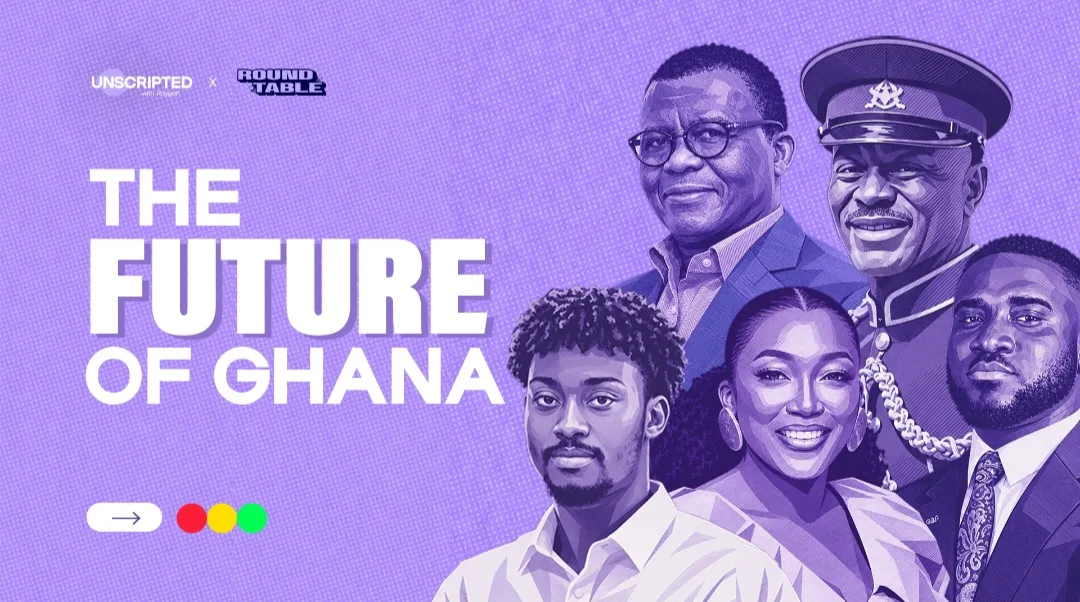
And don't forget to watch the full episode of The Roundtable: The Future of Ghana, live on YouTube now.
Join the conversation as we reflect on the Ghana we have inherited and the Ghana we hope to build.